The problem every shared home eventually hits
Running a household with another person requires two things that are harder than they look: a shared picture of what needs doing, and a way to update that picture without it becoming a second job.
My husband Manuel and I had both. Sort of. We had a whiteboard in the kitchen for the shopping list and a printed sheet on the fridge tracking the freezer inventory. Both worked. We also had a notes app for recurring household tasks. We stopped using it within weeks, and for the next year, tasks fell through the cracks regularly. Not because either of us was irresponsible. Because we had no accurate, shared, low-effort way to know what was overdue and what wasn't.
The friction wasn't dramatic. It was the low-grade kind: the conversation that starts with "did you remember to..." The task that both of us assumed the other had handled. The growing sense that someone was carrying more mental load than the other, without either of us being able to say exactly how much or why.
That's a design problem. And I was in a position to solve it.UX
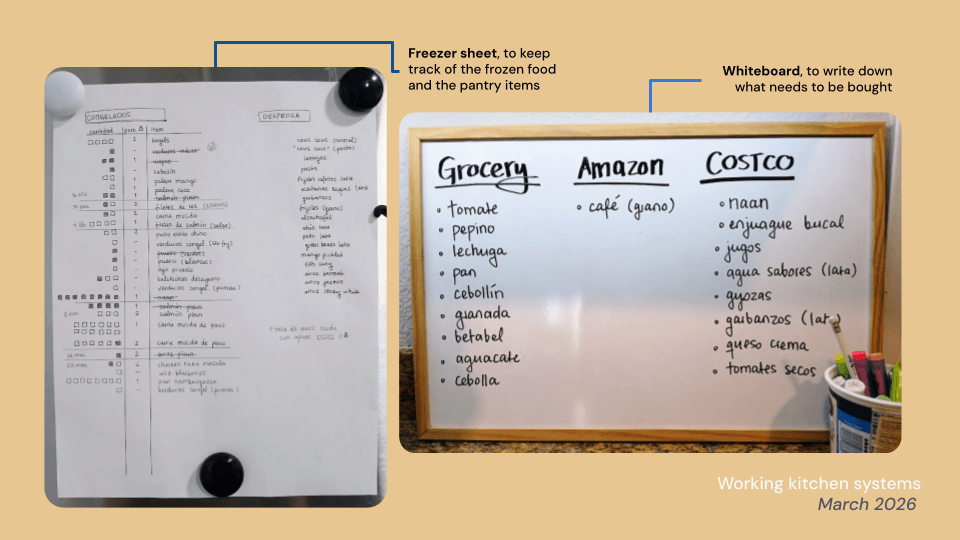
The systems that already worked
Why every tool we tried was wrong about the same thing
Before designing anything, I audited the existing market: Tody, OurHome, Sweepy, and HomeRoutines, plus analogous systems from other domains including kanban boards, ship maintenance logs, and restaurant prep checklists.
The finding was consistent. Every app had made the same four flawed assumptions.BE
| App | Aesthetic | Incentive model | Ownership model | Adapts to real life? |
|---|---|---|---|---|
| Tody | Childlike, colorful | Cleaning scores | Equal split assumed | No (schedule-anchored) |
| OurHome | Cartoon, gamified | Points and rewards | Equal split assumed | No (fixed schedule) |
| Sweepy | Playful, avatar-driven | XP and levels | Equal split assumed | No (date-anchored) |
| HomeRoutines | Cluttered, busy | Streak tracking | Single user focus | No (rigid zones) |
| Casa | Minimal, tool-like | None: task done is the reward | Flexible, reflects real dynamic | Yes (frequency-anchored) |
Competitive Audit: Four Apps, Four Flawed Assumptions
They assumed motivation was the problem. The aesthetic across almost every app was childlike: bright colors, cartoon illustrations, celebratory animations. The implicit diagnosis is that adults need to be coaxed into doing their own housework. We don't. The house working smoothly is its own reward. An interface that treats us otherwise adds noise without adding value.
They assumed adults need external incentives. Points, streaks, rewards. The same logic applied to behavior: add a prize, and people will perform. For two adults who have already decided to maintain their home together, this adds complexity that serves no one. It also assumes that what's missing is motivation, when what's actually missing is clarity.
They assumed a 50/50 split. Most apps assign tasks equally by default. This doesn't reflect how real households work. Manuel commutes to an office. I work from home, which gives me more time and flexibility during the day. Our split is intentional, unequal, and by mutual agreement. A system that enforces artificial equality would have required us to work around it constantly.
They assumed all tasks are equivalent. Making the bed and deep-cleaning the bathroom are not the same kind of task. Treating them identically obscures what actually needs attention and when.
The one analogue I found genuinely useful was the kanban board.IE Simple, visual, resettable, no coordination required to see what needs doing. That logic is present in Casa's urgency model: tasks move through states, the current state is always visible, and either person can act without asking first.
I also considered non-digital formats before committing to an app. A whiteboard in the living room would have required manual updates, making the upkeep itself a task. A shared tablet would have been useless whenever one of us was out of the house. The case for a mobile web app wasn't aesthetic preference. It was functional.UX It updates automatically, it's always with you, and it requires no new hardware or installation.
The second thing the tools got wrong
The apps failed on assumptions. They also failed on a more fundamental model of how recurring tasks actually work.
Every tool we tried was date-anchored. If "water the plants" was due on Tuesday and I did it on Friday, the app thought the next watering was the following Tuesday, because it was tracking the appointment, not the action. Miss one, and every future date is wrong. The system punishes the deviation instead of absorbing it.
No household runs on a perfect schedule. Someone gets sick. Work gets heavy. A weekend trip shifts everything. A system that can't accommodate normal life isn't a system. It's a source of guilt you eventually stop consulting.
The reframe that changed everything: the date doesn't matter. The frequency does.BE I don't need to water the plants every Tuesday. I need to water them roughly every seven days. If I do it on a Friday, the next time is the following Friday. The clock resets from when I acted, not from when I was supposed to act.
This is a small reframe with large consequences. A task done late simply becomes the new baseline. No cascading errors. No system that stops reflecting reality after the first imperfect week.
What the design had to do
With the behavioral diagnosis clear, every design decision had a single test: does this make the system easier to maintain, or harder?
Urgency had to be visible without interpretation. The main view sorts everything by how urgent it is, overdue at the top, on track at the bottom. A colored dot signals state. No numbers to calculate, no dates to compare. You open Casa and immediately know what needs attention.
On-track tasks had to get out of the way. A list where everything is always visible is a list you stop reading. Tasks that are fine collapse into a count by default. The screen shows what needs doing, not everything that exists.
Either person had to be able to act without coordinating first. Some tasks belong to Manuel, some to me, some to whoever gets there first. A shared task doesn't require an assignment before it can be marked done. Either of us can log it and the system updates for both.
The record had to be correctable. Sometimes you forget to log something, or log it on the wrong day. A "last done" field that can be adjusted manually means the urgency calculation stays honest. The record should reflect reality, not the other way around.
Ownership had to be visible but not rigid. Every task has a default owner, but ownership can change. The split reflects the actual dynamic of the household at any given moment, which changes.
What was left out is as deliberate as what was built.UX No notifications. No streaks. No gamification. No guilt mechanics. Everything that added complexity without adding accuracy was cut.
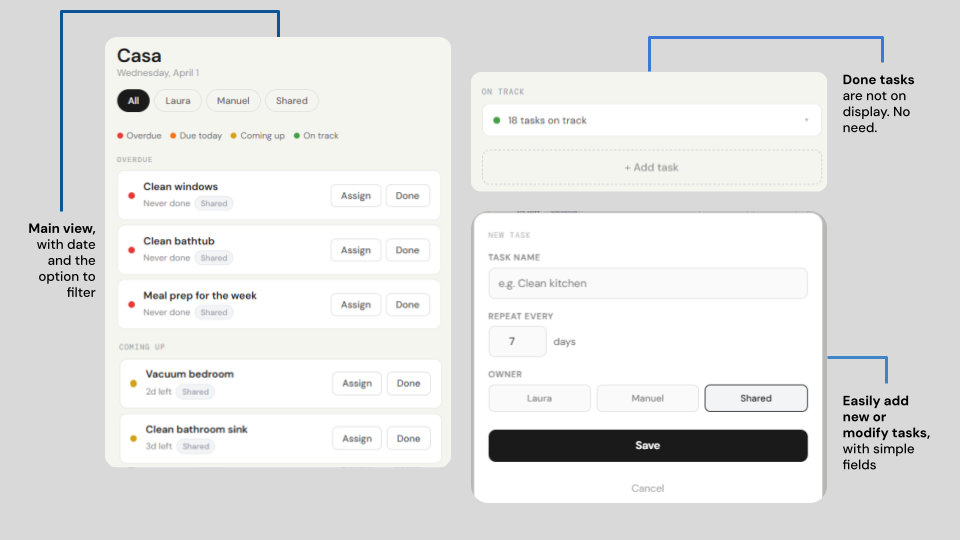
Main View Showing Urgency at a Glance
AI-fluency in practice
Casa was designed and shipped in roughly one day of focused work, split across two sessions. No developer. No agency. No waiting.
I structured the project as a design thinking sprint, one phase per conversation with AI, with full context passed forward at each handoff. Empathize, define, ideate, prototype, test, iterate. Each phase produced a document. Each document became the brief for the next session. The AI built what the brief specified, because the brief was specific enough to build from.
I didn't write any of the code. But I can read HTML, which meant I wasn't supervising blindly. When something didn't match the spec, I described it precisely and the next iteration followed. The feedback loop was tight because the direction was clear.
This is what AI-fluency looks like in practice. Not prompting toward an output. Knowing the problem well enough, and the process well enough, that execution can move fast without losing quality.IE The design thinking wasn't a formality. It was what made the speed possible.
We tested Casa in real daily use for 10 days. Both phones, real tasks, real conditions. The results confirmed what the design had assumed and surfaced what it hadn't, informing the next iteration. A prototype that hasn't been tested in the context it was designed for isn't finished. It's a hypothesis.TL
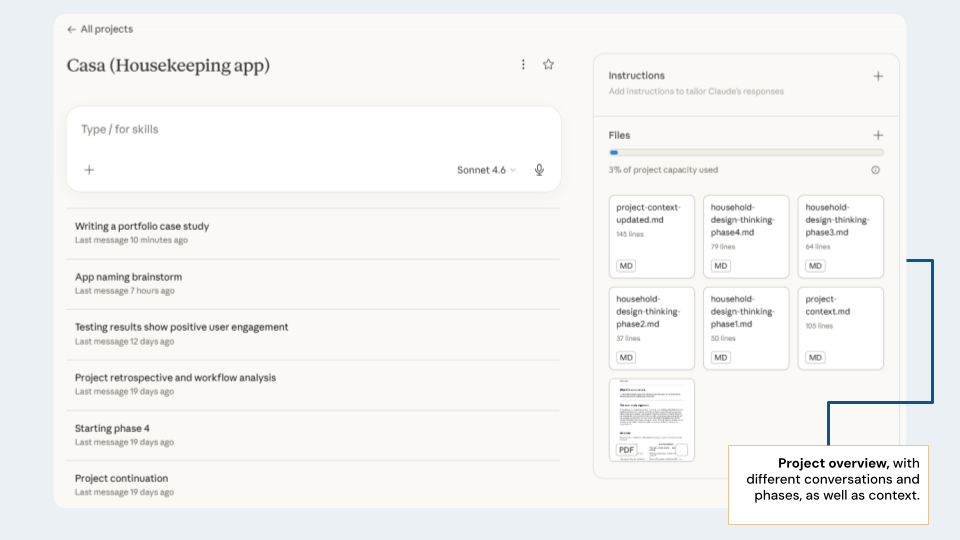
Structured Process With One Phase Per Session
What changed
Before Casa: The mental load of the household was distributed unevenly and invisibly. Tasks fell through the cracks not because either of us was careless, but because there was no shared, accurate picture of what needed doing. Catching up required a conversation. Helping required asking.
After Casa: The app holds the picture. Either of us can open it and know what's overdue, what's coming up, and what's on track, without asking the other person. The coordination that used to require a conversation now requires a glance. We have more time for other things, not because we're doing fewer tasks, but because the mental energy of tracking them is no longer ours to carry.
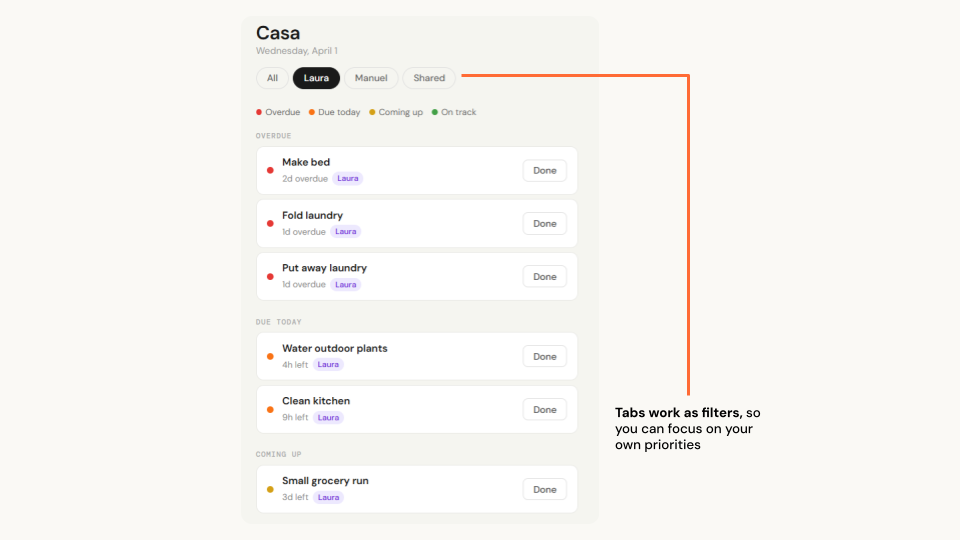
Shared View With Either Person At Any Moment
Reflection
I built this because I was tired of the problem. Not dramatically. In the way that makes you finally precise about what you actually need. A year of trying tools that almost fit had given me a very clear picture of exactly where they failed. That clarity is what made the brief good. And a good brief is most of the design work.
What this project demonstrated concretely is that AI-fluency is a real professional skill with real leverage. The distance between a clear problem and a working product on two phones used to be measured in months. It is now measured in hours, if you know how to close it.
If you've ever had a problem that no existing tool quite solves, you should be able to build your own version. I wrote about how on LinkedIn (read it here), because a skill this transferable shouldn't stay in one person's toolkit.TL
Casa is still running. We're still using it. The fact that I'm writing this on a Thursday and the app is on my phone right now, doing its job, is the outcome worth naming.